There will be time, there will be time
To prepare a face to meet the faces that you meet;
There will be time to murder and create,
And time for all the works and days of hands
That lift and drop a question on your plate;
Time for you and time for me,
And time yet for a hundred indecisions,
And for a hundred visions and revisions
Sunday, March 29, 2009
To Prepare A Face
Monday, January 21, 2008
A Diet of Dreams
I just saw the film “Into the Wild.” It is a different perspective from Krakauer's brilliant biography of Christopher “Alexander” McCandless, but it's telling of the brief enigmatic life of McCandless is no less profound in it's effect on me. It is the story of a life I could nearly have chosen. I highly recommend both the book and film. I have included the response I wrote in my gridbook journal after I first read the book in 2003:I finished "Into The Wild." Who cannot love this reckless young man? What older man cannot read this and see his own self in younger dreamier days? Chris McCandless lived out so many of my boyish fantasies. How many times have I looked longingly into a forest or a mountain range and thought "What if I just left the road and walked out into that?" I read and recall myself running a tiny path through the woods in the heart of a violent storm hearing the ancient trees crashing across the path behind me—exhilarated and feeling more alive than ever. I remember myself wandering the remote mountain villages in Haiti with nothing but a water bottle and a camera.
I recollect hearing Alexander often spoken or even sung about by friends in college; he had already become a sort of patron saint for young men like us. I got out my old CD of songs from college which mentioned McCandless. Listening to Tom singing years ago on these recordings always is emotional for me—relics of a world that no longer exists for me, a world that shaped me. I recall the nights in the cabin beside the fire with other wild-hearted young men singing songs, reading each other our melodramatic poems. We all had bigger dreams and bigger ideas then: meeting before sunrise to sing prayers in the form of Gregorian Chants, because ancient monks had purer hearts than we ...playing soccer naked at midnight after butchering and cooking our own pig ...reading books by men long dead ...growing long beards ...sleeping in abandoned garages and cotton fields as we wandered the back highways without a map ...walking barefoot and reading books in trees.We didn't take things as far as Alexander. We were mostly normal college students who usually slept in beds, flirted with girls, and ate processed foods, but we all had a piece of ourself in another world. When we wanted we could partake in the food of saints and dreamers. Now as an older man I am exclusively a man of the "real world." Alexander turned his back on the "real world" and lived exclusively on a diet of dreams far more vigorous than our occasional tastes, and he died of starvation in his sleeping bag. Who cannot envy this arrogant, foolish boy who never sold out?
My days of risks are over. I have a wife now, I will not run in a hurricane or wander uncharted villages alone again. These minor risks were appropriate for a young man, but now my wife is my priority and I must act responsibly. I am proud to be her husband and would never trade her for any one of McCandless' freedoms. I will soon have patients that depend on me for their life and health, and this will also be good. The ties that bind us are good. There can be virtue in this world too. One of those virtues is discipline. I have a huge test soon, and I have spent an entire day in this book and these sentimental musings. These are things I cannot do. Too many people are trusting me.I leave this now to try to refocus myself on the work that has been set out for me. As I go I say a silent prayer for Jade and Fernando–the last two among us to live so exclusively on a diet of wild dreams–wherever in the world they might be . I could imagine either of them turning up dead on an adventure even more beautiful and foolish than Alexander's, but I pray that they are safe, as I also earnestly pray that they are doing nothing so banal as my work today, that they never give up that which I have chosen to leave behind. Somehow knowing that they are out there living these dreams makes my own burdens feel lighter.

Thursday, December 06, 2007
Death & Christmas
This is a poem I wrote in Haiti after watching a newborn baby (the one in the picture) die. I hope it doesn't lessen your joy of Christmas, but perhaps deepen joy with a perspective we all need: the understanding that our hope was bought with a price.The Incarnation
Why did I ever come forth from the womb to look on trouble and sorrow, so that my days have been spent in shame? -Jeremiah 20:18
Unto us a child is born
Unto us a son is given.
Born of blood,
Born to bleed.
Born into the cold
Born into squalor
Among the filth of animal feces
On the coldest night of the year
Night air carries distant moaning,
The bitter moaning of death vigils.
Many die on such a night.
...and the bloody infant
Miserable yellow jaundice.
Wrap the infant tight,
Lay him shivering in the hay
To be bitten by lice and fleas
And bored through by parasites.
He whines and writhes,
Vomits, then shakes in quiet agony
But the child will not die tonight...
He will live to know more agony
The suffering life of a dirty peasant,
Building with broken hands.
Born of suffering,
Born to suffer.
And pitiful, muffled cries draw
Men of the fields,
ugly and reeking,
Bringing infection to the infant.
Unto us a sickly child is born,
Unto him the plague is given
And the infection of us all
Will be upon his shoulders.
But the wretched one will not die tonight...
He will live to know more agony
To die tormented and alone,
Rather than here in his mother’s arms.
Brought to life this night
Brought to life to die.
In the wretchedness
Of this yellow, shivering body:
Here is the only hope
Of peace and salvation.
Unto us a sickly infant is born.
Through suffering hope is born.
And the weight of the world
Will be upon his shoulders.
And Death will be upon his shoulders
Tremble before your newborn Savior.
…and the Word became flesh, and dwelt among us.
*
Tuesday, October 03, 2006
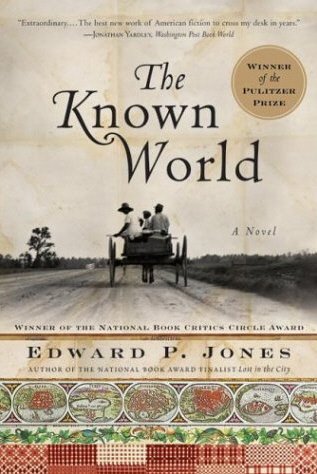
The Known World
I just finished "The Known World" by Edward P. Jones. A book this beautiful and profound deserves both recommendation and discussion here:The Known World tells the story of the fictional Manchester County Virginia in the years before the Civil War. The story centers around a freed slave named Henry Townsend who owns slaves and runs a plantation. The story explores Henry's entire world and the web of people in it. The story makes our common concepts of victims and abusers or race and class seem too trite and weak to explain the complex people of the story. The characters of the book are disconcertingly true to human nature. Even those who act monstrously are shown capable of incredible kindness, and even the most admirable of characters are rife with flaws and always in danger of falling from grace.
The crime of enslaving another human being is at the center of the story, but it is not a story "about slavery." The book examines our inherent bent towards misusing each other, of which slavery is one picture. Most of the book doesn't contain any intentional cruelty at all. The well-meaning people gradually created a world in which abuse and misuse is a part of life. It uncomfortably reminds the reader of how we often interact with each other in today's world. The author approaches his characters with such compassion that instead of righteous indignation we look on them with sympathy, "Father forgive them, they know not what they do." When chaos and violence finally erupts we can realize how easily it rose out of seemingly harmless acts of these well-meaning murderers.
Perhaps the most interesting aspect of this book for discussion are the characters who “knew better.” I think particularly of John Skiffington the kind and honest sheriff. Skiffington is a good man who knows enslaving another human is wrong, but finds no way to avoid that it is a fact of the world in which he lives. He tries to keep the world stable by living righteously and keeping unjust laws as justly as he can, but his seemingly innocent entanglements in the injustices around him bring about his fall from grace and the ensuing chaos. In the end the good sheriff is more responsible for the crimes than the slave owners or the violent men who knew no better way. I found this righteous sheriff the most tragic and disconcerting character in all The Known World.
In a world like our own where the undesired are terminated, the neighbors and children of our enemies are bombed in the name of security, and property is more important than relationships are we not the same? We modern, enlightened people read books about the world of slavery and say, “Well I would have definitely stood up against those injustices!” but The Known World shows how easy it is to live with evil as part of the fabric of the only world you have ever known. Even if we recognize the evils in the world around us, we tend to give our opposition lip-service while benefiting from the security or wealth they provide. Someone like myself with a tendency toward rants might be tempted to call The Known World a "call for action," but it would not be an honest look at the work. The generous Edward P. Jones doesn't ask his characters to save the world, he even forgives them as they are destroying it. Perhaps he hopes with a bit of introspection we might be a little better than our ancestors.If you are looking for a fascinating read I highly recommend The Known World. If you have read it I would love to hear your thoughts on the book...
Monday, June 12, 2006
"The New World"
I don't plan to make it a common occurrence to put my movie reviews on this blog. I want this blog to be about interesting ideas, and not just some random conglomeration of my personal tastes. That being said, however, I find this particular film so thought-provoking and such a powerful work of art that I feel comfortable discussing it here.
If you haven't seen "The New World" you really should watch it as soon as is possible. It is one of the most fascinating films I have ever seen, and perhaps the most beautifully filmed. I have seen it twice now. Like most films by Terrence Malick (director of “The Thin Red Line”) its depth and meaning grows with each viewing. This movie seems to have unfortunately suffered from its own advertising. Many people who went expecting a historical romance along the lines of "Braveheart," encountered a film so subtle and profound it didn't make sense to them. Reviews were mediocre. It floundered in theaters. (Most people expecting a comic strip might find a painting by Rembrandt disappointing.) And yet I would have to say this is the best film I have ever seen.
It has a subtle beauty and profound way of watching its characters that is unlike any film you have likely ever seen. There are only about 100 lines of dialog in the entire film. The rest is simply watching. Never has watching interactions or gestures of the characters reenacting history been so engrossing. The film only briefly plays with myths like the “noble savage” or the “welcoming Pocahontas” only to show its characters to be deeper and more complex imaginations that the audience must interpret themselves. It is always watching… watching the complex interplay of new cultures… watching the years pass… watching people rise and fall then rise again. Most of it has no words at all. (Not in the dull independent film way of watching people doing nothing and calling it art, but in a way that is obviously meaningful and understandable in spite of its depth.) It is told less like a narrative and more like the way someone might remember the events of their life. “The
Watch this film with an open mind and you will find an artistic treasure well worth watching again and again.